

Your Questions,
Answered…
Factually
-
No. We think we're better together.
-
You may not—and we have enormous respect for experienced paralegals who know this work.
A knowledgeable Medicaid paralegal can be one of the most valuable people in an elder-law practice. Attorneys who have developed an experienced Medicaid team may already have exactly the resources they need.
The important word, however, is Medicaid.
Long-term-care Medicaid is a highly specialized area. Understanding how to complete an application is very different from understanding the eligibility strategy behind it. Difficult cases can involve resource rules, spousal impoverishment, transfers, trusts, real estate, income, patient liability, AVS findings, post-eligibility requirements, administrative policy, changing circumstances, and agency decisions that sometimes need to be questioned or challenged.
Medicaid is difficult to dabble in.
A firm may handle only a handful of Medicaid matters each year, and maintaining the depth of knowledge and internal infrastructure necessary for those cases may not make economic sense. An excellent paralegal who hasn't been specifically trained in long-term-care Medicaid can encounter many of the same problems that facilities, financial professionals, families, and other practitioners encounter.
That's where HMS can complement the firm.
We bring Medicaid-specific knowledge and case management to the engagement. We can analyze financial eligibility, identify potential problems before filing, develop the Medicaid component of the strategy in collaboration with counsel, manage documentation and AVS issues, work with the client and family, prepare and monitor the application, respond to verification requests, and continue working the administrative process when a case becomes difficult.
We also understand that difficult Medicaid cases don't always proceed neatly from application → verification → approval.
When FSSA questions a transaction, interprets information differently, requests unexpected documentation, denies an application, suspends benefits, or creates another administrative obstacle, that's not necessarily the point at which the Medicaid strategy failed. It's often the point at which specialized Medicaid knowledge matters most.
The attorney remains the attorney. Your paralegal remains an important part of your team. HMS doesn't need to displace either one.
Instead, we can provide a specialized Medicaid resource when maintaining that expertise entirely within the firm isn't practical—or when a particularly difficult case would benefit from another experienced set of eyes.
You don't have to build an entire Medicaid department to offer your clients sophisticated Medicaid planning. Sometimes you just need the right Medicaid professional at the table.
-
There are two primary ways attorneys and HMS work together, and we establish those roles clearly from the beginning.
Your Medicaid client—you bring HMS in.
An attorney or law firm may already represent a client in a Medicaid or long-term-care planning matter and bring HMS into the case for specialized Medicaid assistance. In that arrangement, the client remains the firm's client, and HMS works within the scope established with counsel.We can assist with financial eligibility analysis, Medicaid planning, calculations, financial documentation, application preparation, AVS and verification issues, policy research, agency communication, case monitoring, and other Medicaid-focused work. The attorney and HMS determine at the outset how responsibilities, communication, authorized representation, and any potential administrative appeal will be handled.
A firm may also choose to refer the Medicaid engagement completely to HMS while continuing to provide the legal services the client needs. In that arrangement, HMS assumes responsibility for the Medicaid engagement and authorized-representative role, while counsel remains available for legal work.
Our Medicaid client—we bring you in.
HMS may already be working with an individual, family, facility, or other client and identify an issue requiring legal expertise. In that situation, we aren't asking the attorney to take over the Medicaid case.We're asking for legal help with a defined issue.
That may include preparing or reviewing a Power of Attorney, deed, trust, affidavit, or other legal instrument; addressing guardianship, probate, or estate-planning issues; reviewing a proposed strategy for legal implications; or providing legal advice or an opinion on a matter outside HMS's scope.
Whenever possible, we'll bring counsel the relevant facts, documentation, Medicaid objective, timing considerations, and preliminary groundwork so the attorney can focus on the legal issue rather than reconstructing the entire Medicaid case.
Counsel independently evaluates the matter, advises the client as appropriate, and determines the legal solution. HMS remains responsible for the Medicaid engagement and continues the Medicaid work once the legal piece is addressed.
The distinction matters because bringing an attorney into a Medicaid case to prepare a trust or provide legal advice doesn't automatically make that attorney responsible for the Medicaid application, FSSA communication, verifications, or an eventual administrative appeal.
Likewise, when a law firm brings HMS into an existing Medicaid representation, we don't simply assume the firm's role or responsibilities.
We define the lanes before we start.
That gives the client the benefit of both specialties while making sure everyone at the table knows who is responsible for what.
Attorney's Medicaid case → HMS assists.
Attorney refers Medicaid case → HMS owns Medicaid; attorney handles legal work.
HMS's Medicaid case → attorney comes in for discrete legal work. -
Absolutely. Sometimes the best time to involve HMS is before anyone has decided what the plan should be.
Consider a common situation: a client's husband has just entered a nursing facility. The couple has a home, vehicles, retirement accounts, savings, perhaps some real estate or other investments, and the wife is suddenly facing the possibility of substantial monthly nursing-home costs.
There may be several legally permissible ways to approach the situation—but each option can have very different consequences for Medicaid eligibility, resource protection, timing, patient liability, and the community spouse's financial security.
HMS is happy to participate in a consultation with counsel and the client when the purpose is to brainstorm, evaluate options, and develop a coordinated long-term-care plan.
Counsel brings the legal analysis and available legal tools. HMS brings the Medicaid eligibility analysis, policy knowledge, calculations, and practical understanding of how the proposed strategy is likely to interact with the Medicaid process.
We can ask questions together:
What does the client own? What is countable? What is exempt? What can appropriately be converted? What should remain available to the community spouse? What legal documents or authority will be necessary? What should happen before an application is filed? What could create a problem later? And what happens to the plan if circumstances change?
Sometimes an idea that looks attractive from an estate-planning or financial perspective creates an unintended Medicaid consequence. Other times, a Medicaid planning opportunity may require a legal mechanism that only counsel can properly evaluate and implement.
Having both perspectives at the table before the plan is implemented can prevent everyone from having to unwind a problem afterward.
HMS doesn't need to control the consultation, and we aren't there to provide legal advice. We're there as a Medicaid resource for both counsel and the client so the team can evaluate the options with the Medicaid consequences in view.
And if the meeting results in a plan, the work can divide naturally from there: counsel handles the legal services, HMS handles the Medicaid planning and implementation within our scope, and we continue communicating when the two intersect.
Sometimes the most valuable thing HMS can contribute isn't an application. It's being in the room while the right plan is being developed.
-
We take that boundary seriously—but we also believe good collaboration should save the attorney time.
HMS provides Medicaid-focused consulting, eligibility analysis, case management, application assistance, administrative advocacy, and practical coordination. We are not a law firm and do not independently provide legal advice or legal services to clients.
Medicaid planning, however, frequently intersects with legal work. A strategy may require a Power of Attorney, deed, trust, affidavit, guardianship, probate proceeding, estate-planning document, or another legal instrument. When the Medicaid strategy requires legal judgment or legal services, that's where counsel comes in.
Our job is to make that transition efficient. We can identify the Medicaid issue, explain the objective, organize the relevant facts and documentation, and—when working with an attorney who wants that support—assist with factual development, calculations, affidavits, or preliminary drafting for the attorney's review and completion.
The attorney remains responsible for the legal analysis, legal advice, and final legal work. HMS remains responsible for the Medicaid work within our agreed scope.
Likewise, if we're reviewing a Medicaid case and recognize that an existing Power of Attorney may not provide authority needed to implement the plan, we flag the issue for counsel rather than attempting to interpret, amend, or replace the instrument ourselves.
The same principle applies when estate planning, property ownership, fiduciary authority, guardianship, probate, or another legal issue affects the Medicaid strategy: we identify the Medicaid problem and bring counsel into the conversation.
That division of labor allows each professional to work where their expertise provides the most value.
HMS handles the Medicaid strategy and groundwork. Counsel exercises the legal judgment.
-
By keeping the attorney—and highly skilled legal staff—focused on the work that actually requires their expertise.
Medicaid cases can consume an enormous amount of professional time that isn't necessarily legal work: collecting years of financial records, tracing transactions, communicating repeatedly with family members, organizing verifications, monitoring deadlines, reviewing AVS results, following up with FSSA, and troubleshooting administrative issues.
HMS can take responsibility for much of that Medicaid-focused workload.
We work directly with the client and family to develop the financial record, analyze eligibility, identify potential problems, gather documentation, implement the Medicaid portion of the plan, manage the application process, and follow the case through determination.
When legal work is needed, we bring the issue back to counsel in an organized form—with the relevant facts, Medicaid objective, supporting documentation, and preliminary groundwork when appropriate.
That can make the attorney's involvement much more targeted.
Instead of spending several hours figuring out why a Medicaid case needs a particular legal solution, counsel can spend that time evaluating the legal issue, advising the client, and determining the appropriate legal action.
It can also allow firms that don't maintain a dedicated Medicaid department to accept appropriate long-term-care planning matters without having to develop an entire internal Medicaid infrastructure for a relatively small number of cases.
And because HMS can remain involved after the legal work is completed, the case doesn't automatically land back on the attorney's desk every time FSSA sends a verification request or AVS identifies another account.
We handle the Medicaid process. We involve counsel when counsel is needed.
The goal isn't to remove the attorney from the case. It's to make the attorney's time in the case count.
-
Our goal is to send you an organized legal issue—not a scavenger hunt.
When HMS identifies a legal issue affecting the Medicaid plan, we'll explain what we've found, why it matters to the Medicaid case, what we're trying to accomplish, and any timing concerns that may affect the strategy.
Whenever appropriate and authorized, we can provide the relevant financial information, supporting documents, calculations, case chronology, family information, Medicaid notices, and other materials we've already gathered so your office doesn't have to start the investigation over again.
For example, instead of simply saying, “We need a deed,” we want counsel to understand why the property is creating a Medicaid issue, how it is currently titled, what the Medicaid objective is, and what deadlines or eligibility dates we're working toward.
If an affidavit is needed, we may already have the underlying facts organized and can assist with preliminary drafting for counsel's review. If an existing Power of Attorney appears insufficient for the Medicaid plan, we'll identify the authority we believe may be needed and provide the relevant facts so counsel can independently evaluate the document and advise the client.
If estate planning for a community spouse is part of the strategy, we'll explain the Medicaid concern we're trying to address—including what could happen to the Medicaid recipient if the community spouse dies first—so counsel can evaluate the appropriate estate-planning solution.
We don't expect the attorney to reverse-engineer the Medicaid strategy from our request.
And we don't expect counsel to accept our conclusion simply because we sent it. The attorney retains independent professional judgment and determines the appropriate legal advice, drafting, and final legal solution.
Once the legal work is complete, HMS can pick the Medicaid portion of the plan back up and continue implementation without requiring the attorney to manage the application, AVS, verification requests, agency follow-up, and other administrative work unless counsel wants to remain involved.
The result is a fairly simple division of labor:
We bring you the facts, the Medicaid problem, the objective, and the groundwork. You determine the legal solution. Then we carry the Medicaid case forward.
-
Absolutely. In fact, that's exactly how we envision many of our attorney relationships working.
When an attorney refers a client to HMS for Medicaid assistance, we respect the existing attorney-client relationship. Our role is to handle the Medicaid services we've been engaged to provide—not to replace counsel or redirect unrelated legal work.
If we identify a legal issue during the Medicaid engagement, our first preference is to work with the client's existing attorney whenever appropriate. We'll explain the issue, provide the Medicaid-related facts and objective, and coordinate with counsel so the legal and Medicaid pieces of the plan work together.
We also won't unnecessarily insert ourselves into matters you're already handling. If you're doing the estate planning, probate, guardianship, real-estate work, or other legal representation, that's your work.
Meanwhile, HMS can manage the Medicaid-intensive portions of the case: financial analysis, eligibility planning, documentation, application preparation, AVS, verification requests, agency communication, monitoring, and other administrative work within our scope.
That division can allow the firm to continue providing sophisticated long-term-care planning without requiring the attorney or staff to personally manage every administrative detail of the Medicaid case.
If something develops that requires legal attention, we'll bring it back to you. If you want to remain closely involved throughout the Medicaid process, we're happy to communicate accordingly. If you'd rather have us handle the Medicaid administration and contact you only when legal input is needed, we can work that way too.
HMS becomes another professional resource available to help you serve them well.
-
As involved as you want or need to be.
Some attorneys prefer to remain closely involved throughout the Medicaid engagement. Others want HMS to manage the day-to-day Medicaid work and contact them only when a legal issue, significant planning decision, or unusual problem requires their attention.
We're comfortable with either model.
At the beginning of the engagement, we'll establish how you want communication handled and what types of developments should come back to your office.
HMS can manage the routine Medicaid workflow—including working with the client and family, gathering and reviewing financial records, monitoring eligibility, managing the application, responding to verification and AVS issues, communicating with FSSA, and keeping the case moving.
If something develops that materially changes the strategy—an unexpected transfer or asset, an inheritance, death of a spouse, property issue, family disagreement, or a question involving legal authority—we recognize when it's time to bring counsel back into the conversation.
At the same time, we don't intend to fill your inbox with every bank statement, verification request, or routine agency communication unless that's the level of involvement you prefer.
The point of involving HMS is to reduce your workload, not create another stream of work for you to manage.
We'll handle the Medicaid case independently where appropriate, keep you informed at the level we've agreed upon, and involve you when your expertise is needed.
You don't have to manage HMS managing Medicaid.
-
That depends on which of us is handling the Medicaid representation.
If HMS is the client's Medicaid representative, a denial does not automatically mean the case gets handed to an attorney. Reviewing adverse actions, determining what went wrong, communicating with FSSA, developing the administrative record, filing an appropriate appeal, and handling the Medicaid fair-hearing process are all services HMS may provide within the scope of our Medicaid engagement.
We start by determining why FSSA took the action. We review the notice, case history, financial documentation, verifications, agency communications, and applicable Medicaid policy. Sometimes something simply needs to be corrected or documented. Other times, we may conclude that the facts and policy support challenging the agency's determination.
We don't appeal simply because we don't like the answer. We appeal when the facts and policy give us a reason to challenge it.
When HMS is the properly designated representative for the Medicaid matter, we can prepare the case for the administrative process, organize the chronology and exhibits, identify applicable Medicaid policy, communicate with the agency, and represent the client through the fair-hearing process as permitted for an authorized non-attorney representative.
If, however, your firm retained the Medicaid representation and brought HMS in to assist, we don't independently take over the representation when a denial occurs. We'll work with counsel to analyze the adverse action, develop the record, research the Medicaid issue, prepare supporting materials, and determine how HMS can best assist with the response or hearing.
There is also an important boundary at the other end of the process. If a matter moves beyond the Medicaid administrative process and requires judicial review or other court proceedings, that's attorney territory. HMS can provide counsel with the developed administrative record, chronology, documentation, policy research, and case history, but legal representation in court belongs with counsel.
The important point is that a denial isn't where HMS stops being useful. Difficult Medicaid cases—and figuring out what to do when FSSA says “no”—are a significant part of what we do.
HMS owns Medicaid → HMS handles the administrative appeal.
Attorney owns Medicaid → HMS supports counsel.
The appeal leaves the administrative arena and becomes court litigation → attorney. -
That depends on the relationship and the scope of the engagement, and we make that clear before the work begins.
If your firm brings HMS into an existing matter to provide specialized Medicaid support, the firm may engage HMS directly for an agreed scope of work. Depending on the project, services may be provided at an hourly rate, for a defined fee, or under another arrangement established with the firm.
If instead you refer the Medicaid matter to HMS, the client can engage and pay HMS directly. Your firm can continue providing whatever legal services the client needs under your own engagement agreement and fee arrangement.
Likewise, when HMS brings an attorney into one of our Medicaid cases, the attorney's legal services remain separate from HMS's Medicaid services. Counsel establishes the appropriate attorney-client relationship, scope, and legal fee for the services being provided.
HMS also recognizes that not every engagement fits neatly into a standard fee schedule.
For example, we may offer reduced professional fees when a long-term-care facility is paying for Medicaid assistance for a resident who does not have the means to engage HMS independently. We may also offer preferred pricing or other arrangements to facilities and professional partners who repeatedly engage HMS for complex cases.
And occasionally, there is simply a situation where someone genuinely needs our help and there is no reasonable way for them to pay for it. Under limited circumstances and at our discretion, HMS may provide some services at reduced cost or without charge.
Those decisions are made case by case. They don't change the value of the work; they reflect our belief that good professional judgment sometimes includes knowing when the standard business model shouldn't control the outcome.
We recognize that attorneys and law firms operate under their own professional obligations, policies, and fee structures. We're not suggesting that counsel adopt HMS's approach. But when we're collaborating on a matter, we're always willing to discuss whether there is a practical way to structure our respective services that makes sense for the client and the professionals involved.
For firms that anticipate using HMS regularly, we're also open to discussing a professional consulting arrangement that makes it easy to bring us into cases when specialized Medicaid assistance is needed.
Before work begins, everyone should understand who the client is, who engaged whom, what each professional is responsible for, and who is paying for each service.
Clear roles. Clear scope. Clear fees. No surprises.
-
Carefully—and only with the people who need it to do their jobs.
Medicaid cases require access to highly personal information: bank records, tax documents, income, property records, trusts, estate-planning documents, medical and long-term-care information, Social Security information, and sometimes years of financial history.
We treat that information accordingly.
When HMS and an attorney are collaborating, we establish the appropriate authorizations and share information necessary to accomplish the work each professional has been engaged to perform. We don't routinely copy every professional involved on every document simply because they're part of the case.
If HMS brings counsel into one of our Medicaid matters, we'll provide the information reasonably necessary for the attorney to understand and address the legal issue. If a law firm brings HMS into its case, we'll work within the information-sharing and communication structure established for that engagement.
We also recognize an important distinction: HMS is not a law firm, and communications with HMS should not automatically be assumed to have the same legal protections as confidential attorney-client communications or attorney work product.
When counsel believes particular information, analysis, or communication requires special handling, we expect to work with the attorney to structure that communication appropriately rather than casually circulating it.
Our practical rule is simple:
Share what is necessary. Protect what we receive. And don't make sensitive client information travel farther than it needs to.
-
Start with a conversation—or a case.
You don't need a formal partnership agreement in place before calling HMS. If you have a Medicaid matter that could benefit from another experienced set of eyes, tell us what's going on.
We can talk through the situation, determine whether HMS is a good fit, and identify which working relationship makes the most sense. Your firm may want HMS to assist with an existing Medicaid representation, refer the Medicaid engagement to us entirely, or simply establish a relationship so you have a Medicaid resource available when an unusual case comes through the door.
Likewise, if you're interested in being available when HMS clients need legal services, we'd like to know more about your practice, the types of matters you handle, and the geographic areas you serve.
We aren't looking for complicated referral arrangements or exclusivity. We're looking for professional relationships with people who are good at what they do, communicate well, respect professional boundaries, and genuinely want good outcomes for clients.
Sometimes that relationship starts with one difficult Medicaid case.
Sometimes it starts over coffee.
Either one works for us.
Contact HMS and introduce yourself. We'll take it from there.
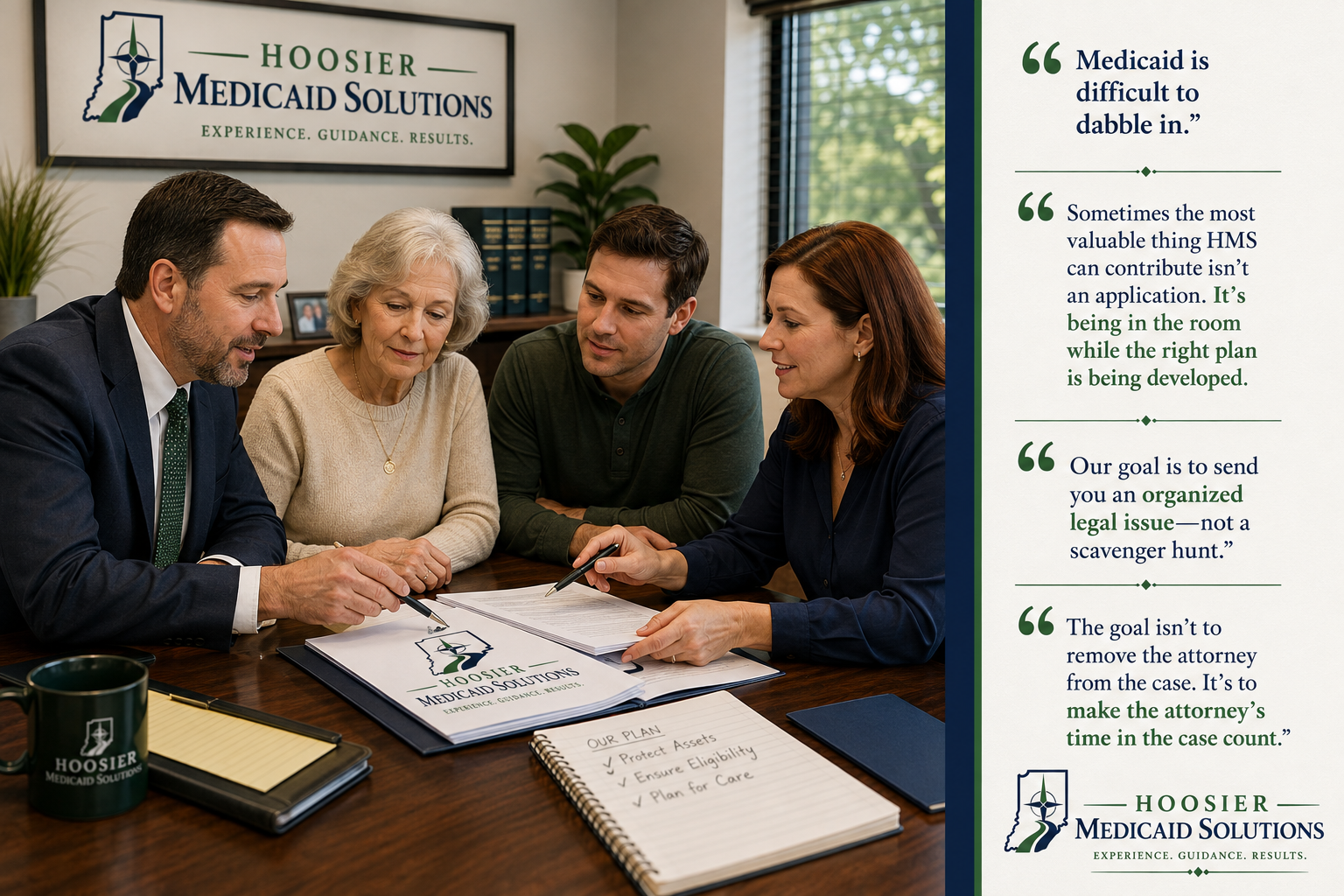
“Sometimes the most valuable thing HMS can contribute isn't an application. It's being in the room while the right plan is being developed.” HMS and Max.